Cyber Threat Landscape
The cyber threat landscape refers to the constantly evolving environment of cyber threats, attack methods, vulnerabilities, and malicious actors. That target individuals, organizations, and governments. As technology has improved, cybercriminals have also developed more Advance and Complex techniques to get illegal data, disrupt services, and demand ransom.
Today, businesses rely heavily on digital systems. Such as cloud computing, mobile devices, and the Internet of Things (IoT). While these technologies improve efficiency. They also create new opportunities for attackers.
Understanding the cyber threat landscape helps organizations identify risks, strengthen defenses, and that may reduce the chances of successful cyber attacks.
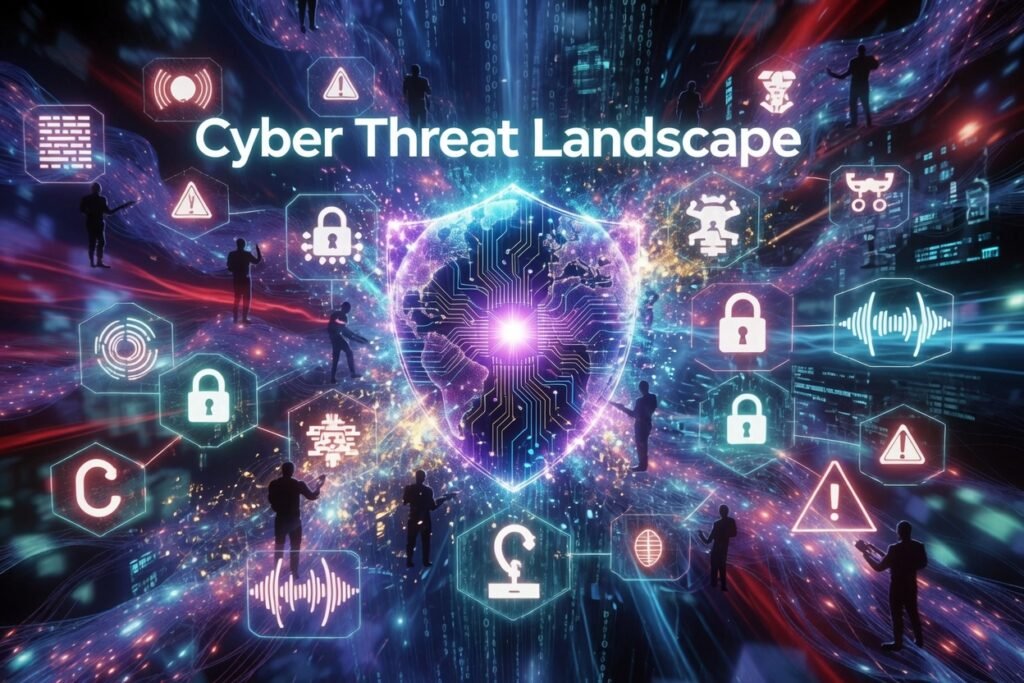
Table of Contents
What Is a Cyber Threat?
A cyber threat is any malicious attempt to get unauthorized access to computer systems. Use for stealing sensitive information. Its cause is to damage digital assets, or disrupt normal operations.
Cyber threats can target:
- Individuals
- Small businesses
- Large enterprises
- Educational institutions
- Healthcare organizations
- Financial institutions
- Government agencies
What Is the Cyber Threat Landscape?
The cyber threat landscape are:
- Cybercriminals
- Attack techniques
- System vulnerabilities
- Emerging technologies
- Security risks
- Global cybersecurity trends
Because attackers improve their methods time by time. That ensures the threat landscape changes every day.
Major Types of Cyber Threats
1. Malware
Malware is malicious software. That is specially designed to damage or infiltrate computer systems.
For Examples:
- Viruses
- Worms
- Trojans
- Spyware
- Rootkits
Example
If the user downloads a free video editing application from an unofficial website. That may be hidden spyware inside the installer. That may silently record your passwords and banking information.
2. Ransomware
Ransomware encrypts files. That demands payment to restore access.
Example
If a hospital’s computer network may become encrypted overnight. Doctors cannot access patient records until the systems are restored from secure backups.
3. Phishing
Phishing tricks users into revealing sensitive information. by using fake emails, websites, or messages etc.
Example
An employee receives an email which shows as coming from Microsoft asking them to verify their Office 365 account. The employee enters their credentials into a fake website and allows attackers to access company email.
4. Social Engineering
Social engineering manipulates people into revealing confidential information.
Example
If someone claims to be an IT technician. Then calls an employee requesting their password to “fix a network issue.” Believing the story of them, the employee shares the password.
5. Distributed Denial-of-Service (DDoS)
A DDoS attack overloads servers with too much traffic. Which causes websites to be unavailable.
Example
An online shopping website experiences millions of fake requests during a holiday sale, preventing real customers from placing orders.
6. Insider Threats
Insider threats which come from employees, contractors, or trusted individuals.
They may be:
- Intentional
- Accidental
- Negligent
Example
An employee by chance uploads confidential customer information to a public cloud storage folder.
7. Password Attacks
Attackers attempt to guess or steal passwords.
Common methods are:
- Brute force attacks
- Dictionary attacks
- Credential stuffing
- Password spraying
Example
If a user uses the same password on multiple websites. When one website suffers a data breach, attackers use the leaked credentials to access the user’s email and banking accounts.
8. Zero-Day Exploits
A zero-day exploit checks the targeted software vulnerability before the vendor releases a security patch.
Example
Hackers discover a flaw in newly released software and exploit it. Before organizations have time to install updates.
9. Supply Chain Attacks
Rather than attacking the target directly. The attackers compromise trusted vendors or software providers.
Example
A company installs a software update from a trusted supplier. That unknowingly contains malicious code introduced during the supplier’s development process.
10. Advanced Persistent Threats (APTs)
APTs involve highly skilled attackers. Who remain inside a network for an extended period while quietly collecting valuable information.
Example
Attackers gain access to a company’s network through a compromised account and spend months. For gathering sensitive intellectual property without triggering security alerts.
Common Cyber Threat Actors
Different groups launch cyberattacks for different reasons.
Cybercriminals
Their primary goal is financial gain.
Examples include:
- Ransomware gangs
- Identity thieves
- Banking malware operators
Hacktivists
Hacktivists attack organizations to promote political or social causes.
Nation-State Attackers
Government-backed groups conduct cyber espionage, intelligence gathering, or attacks on critical infrastructure.
Insider Threats
Employees or contractors may intentionally or accidentally compromise security.
Industries Frequently Targeted
Some sectors are attacked more often because they hold valuable data or provide essential services.
These are following:
- Banking
- Healthcare
- Education
- Government
- Manufacturing
- Retail
- Technology companies
- Energy providers
Factors Driving the Modern Cyber Threat Landscape
There are several trends have increased cyber risks:
- Remote work
- Cloud computing
- Mobile devices
- Artificial Intelligence
- Internet of Things (IoT)
- Weak passwords
- Third-party software
- Human error
How Organizations Can Reduce Cyber Risks
Effective cybersecurity requires multiple layers of protection.
Employee Security Awareness
Regular training helps your employees to recognize the phishing emails, suspicious links, and social engineering attacks.
Multi-Factor Authentication (MFA)
Adding MFA significantly reduces the risk. Your stolen passwords are being used to access accounts.
Regular Software Updates
Keep updating operating systems and applications helps to remove known security vulnerabilities.
Strong Password Policies
These are:
- Long passwords
- Password managers
- Unique passwords for every account
Data Backups
Maintain your data secure offline or cloud backups to recover quickly from ransomware or any hardware failures.
Network Monitoring
Continuous monitoring helps to detect unusual activity. There it detects before it causes major damage.
Endpoint Protection
Today modern antivirus and endpoint detection tools can identify suspicious behavior and block the many attacks.
Case Study
Ransomware Attack on a Small Business
A small accounting firm receives an email. Which appears to contain an important tax document.
If an employee opens the attachment file then.
Within minutes:
- Files become encrypted.
- Accounting software stops working.
- Client records become inaccessible.
- A ransom note appears demanding payment.
Fortunately, the company had:
- Daily offline backups
- Multi-factor authentication
- An incident response plan
Instead of paying the ransom. Then the business restores its systems from backups and resumes operations with minimal downtime. This highlights how preparation and layered security can reduce the impact of cyber attack.
Best Practices for Individuals
For protect yourself by following these habits:
- Enable multi-factor authentication
- Update software regularly
- Avoid suspicious email attachments
- Download software only from trusted sources
- Use strong, unique passwords
- Back up important files
- Monitor financial accounts for unusual activity
Conclusion
The cyber threat landscape continues to evolve as attackers adopt new technologies and techniques. Understanding common threats such as malware, phishing, ransomware, insider threats, and zero-day exploits helps individuals and organizations make informed security decisions. Cyber security is not a one time task. But an ongoing process of awareness, prevention, detection, and response. By combining employee education, modern security tools, regular updates, and strong backup strategies, organizations can significantly reduce their exposure to cyber threats.
FAQ
What is the cyber threat landscape?
The cyber threat landscape is the constantly changing collection of cyber threats, attackers, vulnerabilities, and attack methods affecting digital systems worldwide.
What is the biggest cyber threat today?
Phishing and ransomware remain among the most common and damaging cyber threats because they target both individuals and organizations.
Why is understanding the cyber threat landscape important?
It helps organizations identify risks, improve security measures, and prepare for emerging cyber threats before they cause significant harm.
How can businesses protect themselves from cyber threats?
Businesses should implement multi-factor authentication, employee training, regular software updates, endpoint protection, secure backups, and continuous network monitoring.
Is the cyber threat landscape always changing?
Yes. New vulnerabilities, technologies, and attacker techniques emerge regularly, making cyber security an ongoing process.