Career Paths in Cyber Security Complete Guide with Examples (2026)
Cyber security has become one in the World. Which is the fastest growing industry. As organizations increase the trust on digital technologies. That the demand for professionals who can protect networks, applications, and sensitive data.
Whether you are a student, an IT professional, or someone planning a career change. Cyber security offers you a wide range of exciting opportunities. Protecting networks from hackers to investigating cybercrime. There is a role for almost every interest and skill set.
In this guide, you’ll learn about the most popular career paths in cyber security. That gives you the skills required, certifications, salary expectations, and examples of professionals working in the field.
What Is a Cyber Security Career?
A cyber security career involves protecting computer systems, networks, software, and data from cyber threats which perform hackers such as:
- Malware
- Phishing attacks
- Ransomware
- Data breaches
- Insider threats
- Identity theft
- Distributed Denial-of-Service (DDoS) attacks
The Cyber security experts. That can be jobs in banks, hospitals, governments, schools, technology companies, military organizations, and even small businesses.
Why Choose Cyber Security as a Career?
Cyber security offers many advantages.
High Demand
Millions of cyber security jobs remain unfilled worldwide. Due to a shortage of skilled people.
Excellent Salaries
Cyber security professionals often earn handsome salaries. Because their expertise is highly valuable.
Continuous Learning
Technology evolves rapidly, making cyber security a field where learning never stops.
Diverse Career Options
You can specialize in:
- Ethical hacking
- Cloud security
- Digital forensics
- Security engineering
- Governance and compliance
- Malware analysis
- Threat intelligence
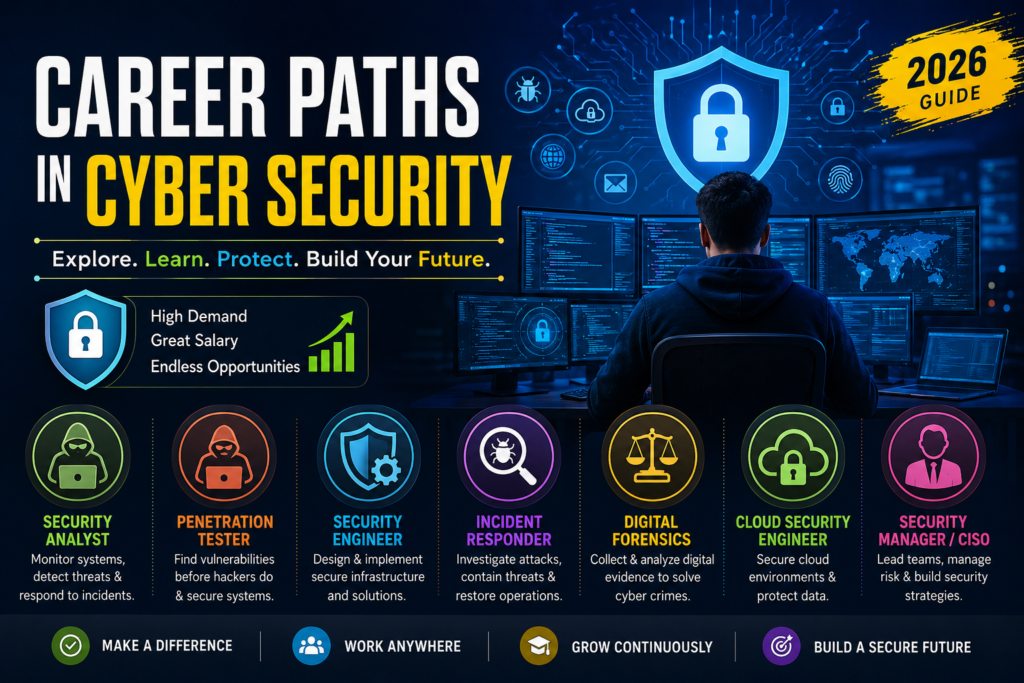
Popular Career Paths in Cyber Security
1. Security Analyst
Responsibilities
A Security Analyst responsibilities are monitoring systems, detecting threats, investigating alerts, and responding to security incidents.
Skills
- Networking
- Windows/Linux
- Firewalls
- SIEM tools
- Incident response
Popular Certifications
- CompTIA Security+
- Google Cybersecurity Certificate
- CySA+
Example
A bank’s Security Analyst notices unusual login attempts from another country. They immediately block the IP addresses, reset affected accounts, and prevent unauthorized access. Before customer data is compromised.
2. Penetration Tester (Ethical Hacker)
Ethically hacks analyze the systems to discover vulnerabilities before criminals attack.
Responsibilities
- Conduct penetration testing
- Find vulnerabilities
- Write security reports
- Recommend fixes
Skills
- Linux
- Networking
- Python
- Web security
- Burp Suite
- Metasploit
Certifications
- CEH
- PNPT
- OSCP
- eJPT
Example
An online shopping company hires an ethical hacker before launching a new website. The penetration tester discovers a SQL Injection vulnerability. That could expose customer information. Developers fix the issue before the website goes live. For preventing a potential data breach.
3. Security Engineer
Security Engineers design and implement secure infrastructure.
Responsibilities
- Configure firewalls
- Secure cloud environments
- Build security architecture
- Manage endpoint protection
Skills
- AWS
- Azure
- Networking
- VPN
- IDS/IPS
- Automation
Example
A company moving its services to the cloud hires a Security Engineer to configure secure access controls, encryption, and monitoring. That ensures customer data remains protected.
4. Incident Responder
Incident Responders investigate and contain cyber attacks.
Responsibilities
- Analyze attacks
- Isolate infected systems
- Recover business operations
- Collect evidence
Skills
- Digital forensics
- SIEM
- Malware analysis
- Log analysis
Example
A hospital is hit by ransomware. The Incident Response team quickly disconnects infected devices. Then restores systems from backups, and coordinates recovery to minimize disruption to patient care.
5. Digital Forensics Investigator
Digital Forensics experts investigate cybercrime after incidents occur.
Responsibilities
- Recover deleted files
- Analyze digital evidence
- Prepare legal reports
- Support law enforcement
Skills
- Disk imaging
- Memory analysis
- Evidence handling
- File system analysis
Certifications
- CHFI
- GCFA
Example
After an employee steals confidential company documents, forensic investigators recover deleted emails and USB activity logs that help prove the data theft.
6. Malware Analyst
Malware Analysts study malicious software to understand how it works.
Responsibilities
- Reverse engineer malware
- Analyze ransomware
- Create detection rules
Skills
- Assembly language
- Reverse engineering
- Windows internals
- IDA Pro
- Ghidra
Example
A security company analyzes a new ransomware sample and develops detection signatures. That protects thousands of customers before the malware spreads widely.
7. Cloud Security Engineer
Cloud Security Engineers protect cloud-based systems and applications.
Responsibilities
- Secure AWS, Azure, or Google Cloud
- Configure Identity and Access Management (IAM)
- Monitor cloud activity
Skills
- Cloud architecture
- IAM
- Containers
- Kubernetes
- Encryption
Certifications
- AWS Security Specialty
- Microsoft Azure Security Engineer
Example
A software company stores customer information in AWS. The Cloud Security Engineer enforces multi-factor authentication (MFA), encryption, and least-privilege access, reducing the risk of unauthorized access.
8. Security Consultant
Consultants advise organizations on improving their security posture.
Responsibilities
- Risk assessments
- Security audits
- Compliance guidance
- Security planning
Example
A retail company preparing for PCI DSS compliance hires a consultant to review payment systems, identify security gaps, and recommend improvements before the audit.
9. Cyber Security Manager
Managers oversee security teams and organizational security strategies.
Responsibilities
- Lead security teams
- Develop policies
- Manage budgets
- Coordinate incident response
Skills
- Leadership
- Risk management
- Communication
- Project management
10. Chief Information Security Officer (CISO)
The CISO is the executive responsible for an organization’s overall cyber security strategy.
Responsibilities
- Develop security strategy
- Manage security budgets
- Report to executives
- Ensure regulatory compliance
Large enterprises often trust a CISO to align cyber security. That initiatives with business objectives and manage enterprise wide risk.
Skills Needed for Cyber Security Careers
Technical skills:
- Networking
- Linux
- Windows
- Python
- PowerShell
- Cloud Computing
- Firewalls
- VPNs
- SIEM
- Digital Forensics
- Vulnerability Assessment
Soft skills:
- Problem-solving
- Communication
- Teamwork
- Critical thinking
- Time management
- Analytical mindset
Best Certifications
For beginners:
- Google Cybersecurity Certificate
- CompTIA Security+
- ISC2 Certified in Cybersecurity (CC)
Intermediate:
- CySA+
- CEH
- eJPT
- PNPT
Advanced:
- CISSP
- OSCP
- GIAC Certifications
- AWS Security Specialty
- CCSP
Typical Career Roadmap
- Learn networking and operating systems.
- Understand cyber security fundamentals.
- Practice in virtual labs such as TryHackMe or Hack The Box.
- Earn an entry-level certification.
- Build a home lab and portfolio.
- Apply for Security Analyst or SOC Analyst roles.
- Gain experience and specialize in an area of interest.
- Pursue advanced certifications and leadership opportunities.
Industries Hiring Cyber Security Professionals
- Banking and Finance
- Healthcare
- Government
- Education
- Telecommunications
- E-commerce
- Cloud Service Providers
- Manufacturing
- Energy
- Technology Companies
Conclusion
Cyber security is a dynamic and rewarding career field with a wide range of opportunities. Which from entry-level Security Analyst positions to executive leadership roles. Such as CISO. By developing strong technical skills, earning respected certifications, and gaining practical experience through labs and projects. You can build a successful career protecting organizations from evolving cyber threats.
Whether your interest lies in ethical hacking, cloud security, digital forensics, or incident response. There is a cyber security career path. That matches your strengths and long term goals. Investing in continuous learning and hands-on practice will help you stay competitive in this rapidly changing industry.
FAQ
Which cyber security career is best for beginners?
Security Analyst or SOC Analyst roles are excellent starting points because they provide hands-on experience with monitoring, detection, and incident response.
Do I need a computer science degree?
No. Many employers value practical skills, certifications, and hands-on experience alongside or even in place of a formal degree.
Which programming language should I learn?
Python is one of the most useful languages for automation, scripting, and security tasks. Knowledge of Bash and PowerShell is also beneficial.
Is cyber security a good career in 2026?
Yes. The growing frequency of cyber threats and digital transformation across industries continue to drive strong demand for skilled cyber security professionals.