
Complete Cyber Security Course: Beginner to Professional
In today’s digital world, almost everything we do depends on technology. We use computers, smartphones, websites, online banking, social media, and cloud services. Which used to communicate, work, study, and store important information. While technology makes life easier, it also creates opportunities for cyber criminals to steal data, damage systems, spread malware, and commit online fraud. This is where Cyber Security becomes essential.
Cyber Security is the practice of protecting computers, networks, applications, devices, and data from unauthorized access, cyberattacks, and other digital threats. It uses technologies, security controls, policies, and best practices to keep information confidential, accurate, and available to authorized users.
For example, when you log in to your online banking account, security measures such as passwords, multi-factor authentication, encryption, fraud detection, and network security help protect your account and financial information. Similarly, businesses use firewalls, antivirus software, intrusion detection systems, access controls, encryption, and security monitoring to protect their digital infrastructure.
Cyber threats are constantly evolving. Attackers may use phishing, ransomware, malware, password attacks, social engineering, data breaches, and denial-of-service attacks to target individuals and organizations. Understanding how these attacks work and how to prevent them is therefore important for everyone who uses digital technology.
In this complete guide, you will learn the fundamentals of Cyber Security, common types of cyber threats, security technologies, prevention techniques, with examples, and best practices for protecting your devices, accounts, networks, and sensitive data.
Complete Cyber Security Course
Beginner to Professional
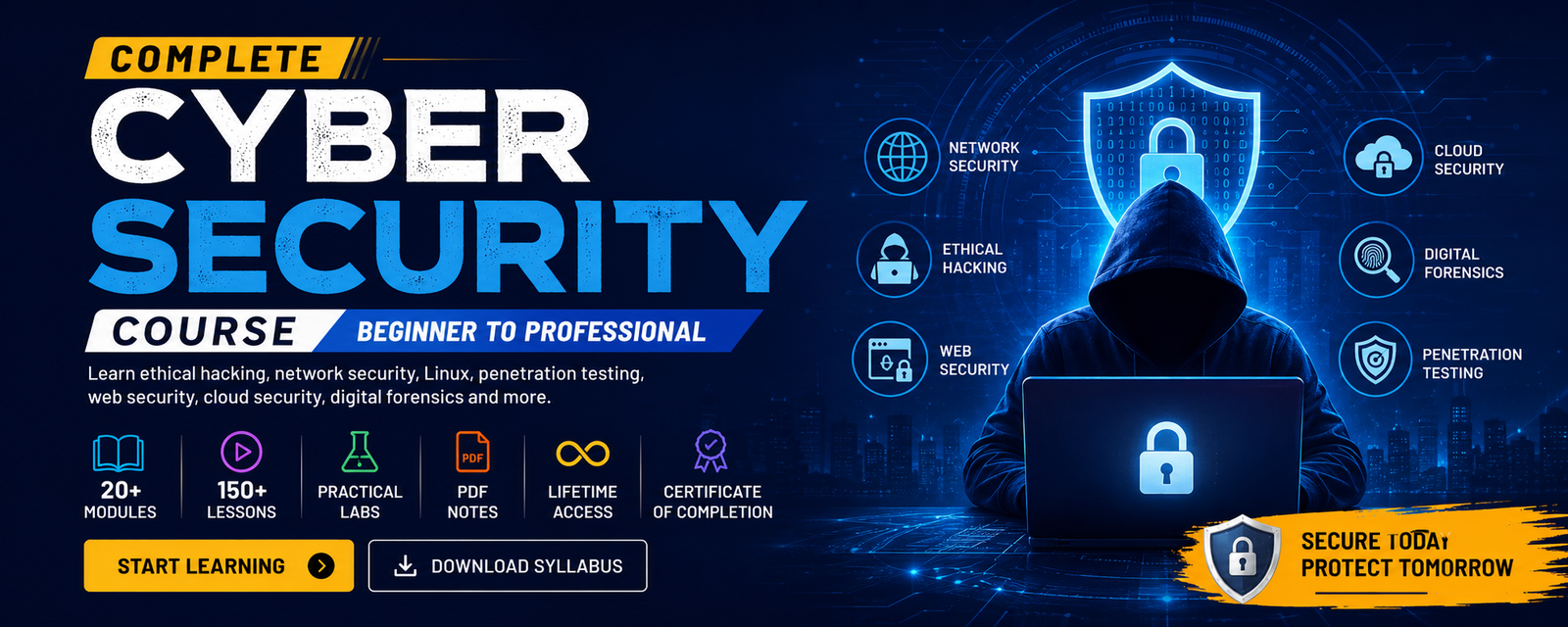
Learn ethical hacking, network security, Linux, penetration testing, cloud security, digital forensics, and more.
Course information
Beginner → Professional
📝 Practical Labs
📄 PDF Notes
⏱ Lifetime Access
🌐 English
Course Statistics
What You’ll Learn?
- Network Security
- Ethical Hacking
- Linux
- Windows Security
- Cloud Security
- Web Security
- Digital Forensics
- Malware Analysis
- SOC
- Secure Coding
Course Road Map
Introduction to Cyber Security
5+ Lessons
Computer Fundamentals
6+ Lessons
Networking Fundamentals
8+ Lessons
Linux Fundamentals
10+ Lessons
Learning Timeline
Practical Labs
🐧 Install Kali Linux

30 Minutes
🌐 Network Scanning
45 Minutes🔒 Wireshark Lab🛡 Firewall Configuration🧪 DVWA PracticeTools You’ll Learn
Kali Linux Wireshark, NmapBurp SuiteMetasploitVirtualBox,
VMwareNessus, Git,
Linux TerminalCareer Paths
SOC AnalystPenetration TesterSecurity AnalystIncident ResponderNetwork Security EngineerCloud Security EngineerCertifications
Security+ Network+CEHeJPTPNPTOSCP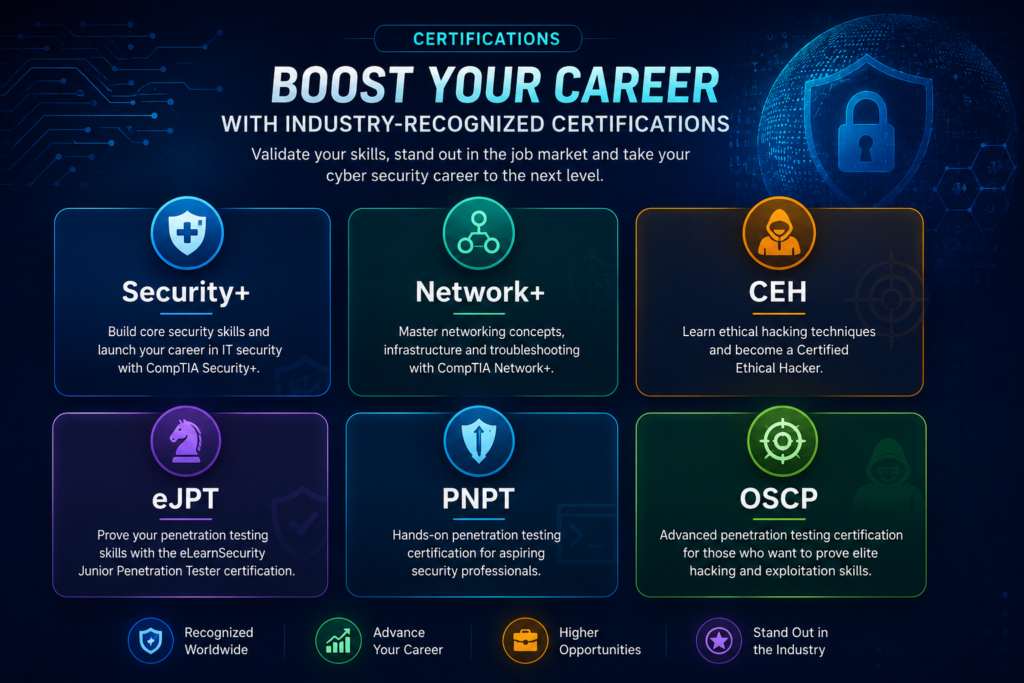
FAQ
Is this Cyber Security course suitable for beginners?
Yes. This course starts with the fundamentals of computers, networking, Linux, and cyber security before progressing to advanced topics such as penetration testing, cloud security, and digital forensics.
Do I need any prior programming experience?
No. Programming knowledge is not required to begin. Basic scripting concepts are introduced where needed, making the course accessible to beginners.
What topics are covered in this course?
The course includes:
Cyber Security Fundamentals
Computer & Networking Basics
Linux and Windows Security
Web Security
Ethical Hacking
Penetration Testing
Malware Analysis
Digital Forensics
Cloud Security
Security Operations (SOC)
Secure Coding
Incident Response
Security Compliance
Are practical labs included?
Yes. The course includes hands-on labs, guided exercises, and real-world scenarios to help you apply the concepts you learn.
Will I receive downloadable PDF notes?
Yes. Many lessons include downloadable PDF notes, checklists, and reference materials for offline study.
Is this course free?
Yes, Core lessons are available for free on SEO Code Hub. Some advanced resources, downloads, or future premium content may require registration or purchase.
Can I learn at my own pace?
Yes. The course is self-paced, allowing you to learn whenever it fits your schedule.
How long does it take to complete the course?
The completion time depends on your learning pace. Most learners can finish the complete course in 2–6 months with consistent study and lab practice.
Who should take this course?
This course is ideal for:
Beginners interested in cyber security
Students
IT Support Professionals
Network Administrators
Web Developers
System Administrators
Career changers
Anyone preparing for a cyber security career
Will I work on real-world projects?
Yes. The course includes practical projects, vulnerability assessments, security labs, and a capstone project to build hands-on experience.
What career opportunities can this course help me pursue?
After completing the course, you can pursue roles such as:
Cyber Security Analyst
SOC Analyst
Penetration Tester
Ethical Hacker
Network Security Engineer
Security Consultant
Incident Responder
Cloud Security Engineer
How often is the course updated?
The course is updated regularly to reflect the latest cyber security trends, tools, vulnerabilities, and best practices.