Hydra What Is Hydra and How Does It Work?
Hydra is a popular command line tool used in cybersecurity and authorized security testing to assess the strength of authentication services. Security professionals and penetration testers can use Hydra to test whether accounts are protected against weak or easily guessed passwords.
In this guide, we will explain what is Hydra, how it works at a high level, what the Hydra app refers to, and provide a practical example.
Important: Hydra should only be used on systems, accounts, and services that you own or have explicit permission to test. Unauthorized password attacks can be illegal.
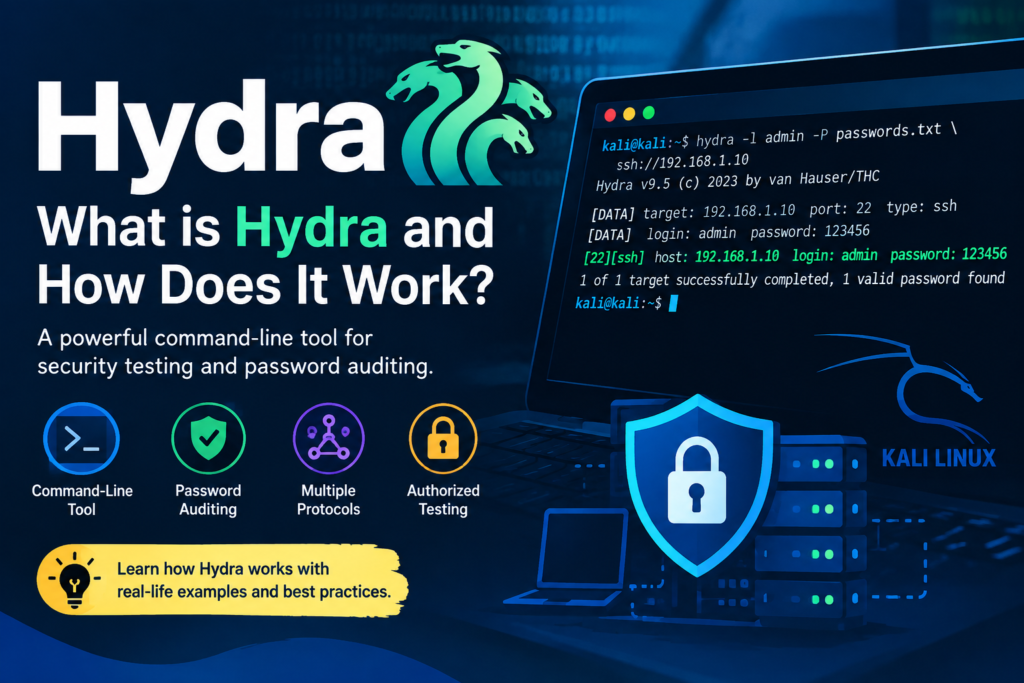
Table of Contents
What Is Hydra?
So, what is Hydra?
Hydra, commonly known as THC Hydra, is an open source network login auditing and password testing tool. It was designed to help security testers evaluate authentication mechanisms across various network services.
Instead of manually testing one password at a time, Hydra can automate authentication attempts against supported services. This makes it useful during authorized penetration tests and security assessments.
Hydra is commonly associated with security testing on Linux distributions such as Kali Linux.
Key Features of Hydra
Some important characteristics of Hydra include:
- Command line based operation
- Support for multiple network authentication protocols
- Automated authentication testing
- Password auditing capabilities
- Useful for penetration testing laboratories
- Open source availability
- Integration into many security testing environments
How Does Hydra Work?
At a high level, Hydra performs repeated authentication attempts against a permitted target.
A typical security assessment looks like this:
Target Service → Hydra → Authentication Attempts → Server Response → Security Assessment
For example, a penetration tester may have permission to test an organization’s SSH server. The tester can use Hydra to determine whether weak credentials could make the service vulnerable to password guessing attacks.
The objective should not simply be to obtain a password. The purpose of an authorized assessment is to identify weaknesses and recommend protections.
What Is the Hydra App?
People sometimes search for Hydra app when looking for the Hydra security tool.
THC Hydra is primarily a command line cybersecurity tool, rather than a conventional graphical mobile application. It is commonly used from Linux terminals and is particularly well known among penetration testers and cybersecurity students.
There can also be unrelated applications or projects using the name “Hydra,” so it is important to check the developer and project description before downloading anything.
Hydra and Kali Linux
Hydra is widely used in cybersecurity training environments, including Kali Linux.
A typical learning setup might contain:
- Kali Linux as the security testing machine
- A deliberately vulnerable lab machine
- An isolated virtual network
- Test accounts created specifically for the exercise
- Hydra for authentication security testing
This type of environment allows students to understand password security without attacking systems.
Example of Hydra
Imagine a company asks a penetration tester to evaluate the security of its internal SSH server.
The company provides:
- Written authorization
- The IP address of the test server
- A test account
- A controlled password testing scope
The tester discovers that the account uses a weak password.
During the authorized assessment, Hydra can be used to test the authentication service against an approved set of test credentials.
If the service accepts a weak password, the tester can document the finding.
Security Finding
The report might state:
Finding: Weak password protection
Risk: An attacker could potentially make repeated authentication attempts and discover weak credentials.
Recommendation:
- Use long, unique passwords.
- Enable multi factor authentication where supported.
- Implement account lockout or throttling controls.
- Restrict unnecessary remote authentication.
- Monitor authentication failures.
- Use strong password policies.
- Consider SSH keys instead of password authentication where appropriate.
This demonstrates the legitimate purpose of Hydra: helping security professionals identify authentication weaknesses so they can be fixed.
Hydra vs Manual Password Testing
Manual testing requires a security tester to enter credentials individually. This can be slow and difficult to manage during an authorized assessment.
Hydra automates the repetitive authentication testing process.
| Method | Description |
| Manual testing | Credentials are tested individually |
| Hydra | Authentication testing can be automated |
| Security assessment | Results are analyzed to identify weaknesses |
Automation makes testing more efficient, but authorization and scope remain essential.
Why Is Hydra Important in Cybersecurity?
Authentication is one of the most important security controls in an information system.
If an organization allows unlimited login attempts and users have weak passwords, attackers may have more opportunities to compromise accounts.
Security professionals can use tools such as Hydra in controlled assessments to identify these weaknesses before criminals exploit them.
Hydra therefore fits into a broader penetration testing methodology that includes:
- Reconnaissance
- Enumeration
- Vulnerability identification
- Authentication testing
- Exploitation where authorized
- Reporting
- Remediation
How to Protect Against Password Attack Tools
Understanding Hydra also helps administrators understand how to defend systems against automated authentication attempts.
1. Use Strong Passwords
Passwords should be long, unique, and difficult to guess.
2. Enable Multi Factor Authentication
MFA adds another authentication factor, reducing reliance on passwords alone.
3. Implement Rate Limiting
Services can restrict the number of authentication attempts within a specific period.
4. Monitor Failed Logins
Repeated failed authentication attempts can indicate password guessing activity.
5. Use Account Lockout Carefully
Temporary account lockouts can reduce automated guessing, although poorly designed lockout policies can also create denial of service opportunities.
6. Disable Unnecessary Services
If a network service is not required, disabling it reduces the available attack surface.
7. Prefer Strong Authentication
Where appropriate, organizations can use mechanisms such as SSH public key authentication instead of password based authentication.
Is Hydra Legal to Use?
Hydra itself is a legitimate security testing tool. However, how and where you use it matters.
Using Hydra against an account, server, website, or network without authorization can violate laws, organizational policies, or terms of service.
For learning, use:
- Your own systems
- Authorized penetration testing environments
- Capture the Flag platforms
- Intentionally vulnerable virtual machines
- Cybersecurity training labs
Never test random websites or accounts simply because they are publicly accessible.
Hydra in a Cybersecurity Learning Lab
Beginners can create an isolated virtual lab containing two virtual machines:
Machine 1: Kali Linux
Machine 2: Deliberately vulnerable test server
The machines can communicate through an isolated virtual network.
Students can then study:
- Authentication
- Password security
- Network services
- Login failures
- Rate limiting
- Account protection
- Security monitoring
This approach provides practical experience while keeping testing within an authorized environment.
Conclusion
Hydra is an important tool for learning about authentication security and penetration testing. Understanding what is Hydra can help cybersecurity students recognize how automated login attempts work and why strong authentication controls are necessary.
The Hydra app is commonly searched for by people looking for the tool, but THC Hydra is primarily a command line security testing utility. It should always be used in an authorized laboratory or during a permitted security assessment.
The most important lesson is not simply how an attack tool works—it is how organizations can use security testing to discover weaknesses and improve authentication defenses.
FAQ
What is Hydra?
Hydra, or THC Hydra, is an open source command line tool used by cybersecurity professionals for authorized login and password security testing against supported network services.
What is the Hydra app?
The term Hydra app can refer to Hydra related software, but THC Hydra itself is primarily a command line security testing tool rather than a typical mobile application.
Is Hydra a hacking tool?
Hydra is a penetration testing and password auditing tool. It can be used by security professionals to identify weak authentication, but unauthorized use against systems or accounts is not appropriate.
Is Hydra available on Kali Linux?
Yes. Hydra is commonly available in Kali Linux and is widely used in cybersecurity education and authorized penetration testing environments.
Can beginners learn Hydra?
Yes. Beginners can learn Hydra safely by using an isolated cybersecurity laboratory and intentionally vulnerable systems designed for training.
Does Hydra crack passwords?
Hydra is designed to automate authentication attempts against supported services. It is commonly described as a login/password auditing tool rather than a general purpose password hashing cracker.