Group Policy Complete Guide with Easy Examples
What is Group Policy?
Group Policy is a feature in Microsoft Windows Server that allows system administrators to centrally manage, configure, and enforce settings for computers and users in an Active Directory (AD) environment.
Instead of configuring every computer individually, an administrator can create a policy once and automatically apply it to hundreds or even thousands of computers.
Think of Group Policy as a set of rules that Windows computers must follow.
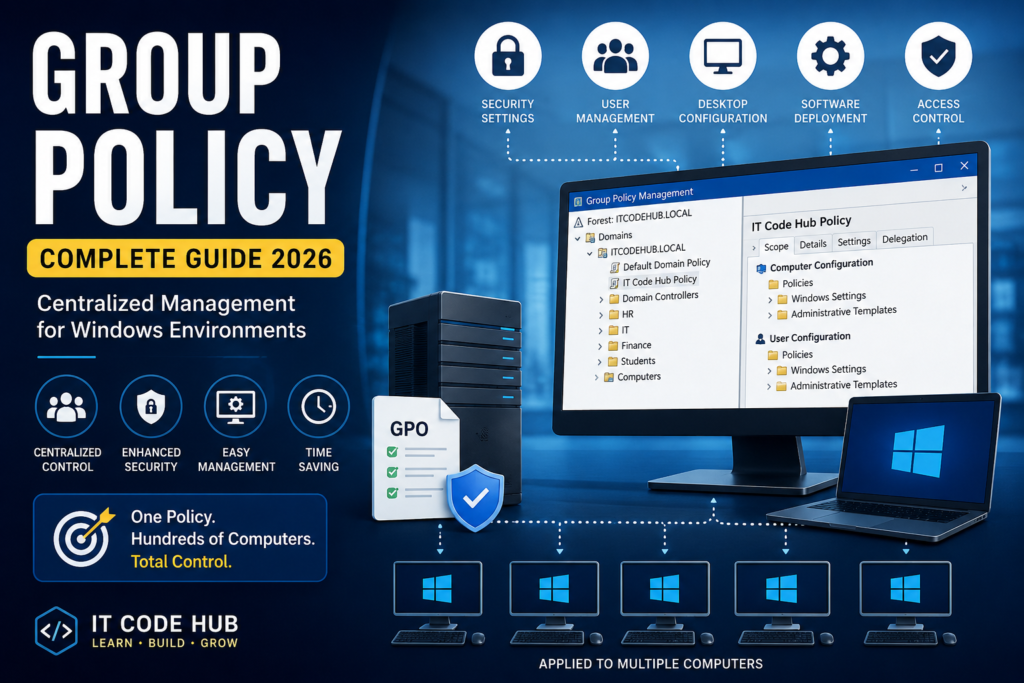
Simple Definition
Group Policy is a centralized management tool that controls the behavior and security settings of users and computers in a Windows domain.
Table of Contents
Why is Group Policy Important?
Without Group Policy:
- Every PC must be configured manually.
- Security settings may differ.
- Users can change important configurations.
- Managing large organizations becomes difficult.
With Group Policy:
- All computers follow the same rules.
- Security improves.
- Administration becomes easier.
- Time is saved.
Example
Spouse that you own a school with 500 computers.
You don’t want students to:
- Install games
- Change desktop wallpaper
- Access Command Prompt
- Use USB drives
- Change system date and time
Doing this manually on 500 computers would take days.
Instead:
- Open Group Policy Management.
- Create one policy.
- Apply it to the Students Organizational Unit (OU).
Within minutes:
✔ Every student computer follows the same rules.
This is the power of Group Policy.
Another Example (Office)
A company has:
- 250 Employees
- 250 Computers
The IT department wants to:
- Change everyone’s desktop wallpaper
- Install Microsoft Office
- Disable USB storage
- Require complex passwords
- Lock computers after 10 minutes
- Automatically map network drives
Instead of visiting every computer, the administrator creates one Group Policy.
When employees log in, every setting is applied automatically.
How Group Policy Works
Administrator
│
▼
Create Group Policy
│
▼
Active Directory
│
▼
Domain Controller
│
▼
Client Computers
Whenever users log in or computers start, they receive the latest policy from the domain controller.
Types of Group Policy
1. Local Group Policy
Applies to one computer only.
Example:
You configure settings on your personal laptop.
Path:
gpedit.msc
2. Domain Group Policy
Applies to multiple computers in an Active Directory domain.
Example:
A university applies one password policy to all staff computers.
Group Policy Objects (GPO)
A Group Policy Object (GPO) is a collection of settings that can be linked to:
- Site
- Domain
- Organizational Unit (OU)
Example:
Company Domain
│
├── HR
├── Finance
├── IT
└── Sales
Each department can have different policies.
User Configuration vs Computer Configuration
User Configuration
Applies to users regardless of the computer they use.
Examples:
- Desktop wallpaper
- Start Menu
- Control Panel restrictions
- Folder Redirection
Computer Configuration
Applies to the computer regardless of who logs in.
Examples:
- Windows Firewall
- Windows Update
- BitLocker
- Device restrictions
Common Group Policy Settings
Password Policy
Example:
Minimum Length:
12 Characters
Password Expiry:
90 Days
Account Lockout:
5 Failed Attempts
Disable USB Storage
Useful in:
- Banks
- Hospitals
- Government offices
Benefits:
- Prevents data theft
- Blocks malware
- Improves security
Restrict Control Panel
Prevent users from changing:
- Date & Time
- Network settings
- Installed programs
- User accounts
Desktop Wallpaper
Many organizations enforce a company wallpaper.
Example:
IT Code Hub
“Learn • Build • Grow”
Every employee sees the same desktop background.
Windows Updates
Administrators can:
- Schedule updates
- Delay updates
- Force installation
- Restart computers automatically after business hours
Software Installation
Software like:
- Google Chrome
- Microsoft Office
- Adobe Reader
- Zoom
can be deployed automatically to all domain computers.
Folder Redirection
Folders such as:
- Desktop
- Documents
- Downloads
can be redirected to a file server.
Benefits:
- Easier backups
- Access files from different computers
- Better data protection
Group Policy Processing Order
Windows applies policies in the following order:
Local
↓
Site
↓
Domain
↓
Organizational Unit (OU)
This order is commonly remembered using the acronym LSDOU:
- L = Local
- S = Site
- D = Domain
- OU = Organizational Unit
If multiple policies conflict, the policy processed later generally has higher precedence, although inheritance, enforcement, and block inheritance can affect the final result.
Group Policy Management in Windows
Group Policy Management (GPM) is a Windows feature used by administrators to centrally configure and control computers and user accounts in a Windows domain environment.
It is mainly used with Active Directory Domain Services (AD DS) in organizations.
What is Group Policy?
A Group Policy Object (GPO) contains settings that administrators can apply to:
- Users
- Computers
- Organizational Units (OUs)
- Windows domain environments
For example, an administrator can use Group Policy to prevent standard users from accessing certain Windows settings.
Common Group Policy Examples
| Policy | Example |
| Password Policy | Require strong passwords |
| Account Lockout | Lock an account after failed login attempts |
| Windows Firewall | Configure firewall rules |
| Windows Update | Control update behavior |
| Software Restriction | Prevent unauthorized applications |
| USB Storage | Disable USB storage devices |
| Control Panel | Prevent users from changing settings |
| Desktop Settings | Configure wallpapers and UI settings |
| Login Scripts | Run scripts when users sign in |
| Security Settings | Configure Windows security policies |
How Group Policy Works
A typical domain environment works like this:
Domain Controller → GPO → Organizational Unit → User/Computer
For example:
An administrator creates a GPO that disables USB storage → links it to the “Employees” OU → computers/users in that OU receive the policy.
Important Group Policy Tools
1. Group Policy Management Console (GPMC)
Used by administrators to create, edit, link, and manage GPOs in an Active Directory environment.
2. Local Group Policy Editor (gpedit.msc)
Used to configure policies on an individual Windows computer.
Press:
Win + R
Then type:
gpedit.msc
and press Enter.
3. Group Policy Management (gpmc.msc)
On supported Windows Server installations with the appropriate management tools, this opens the Group Policy Management Console.
Local vs Domain Group Policy
| Local Group Policy | Domain Group Policy |
| Applies to one computer | Can apply across many computers/users |
| Managed locally | Managed centrally |
| gpedit.msc | GPMC |
| Useful for standalone PCs | Common in organizations |
| No Active Directory required | Normally uses Active Directory |
Group Policy Processing Order
A commonly taught processing order is:
Local → Site → Domain → OU
This is often remembered as LSDOU.
Policies applied later can generally take precedence when settings conflict, subject to Group Policy processing rules and configurations such as Block Inheritance and Enforced.
Useful Command
To immediately refresh Group Policy:
gpupdate /force
To generate a report showing the policies applied to a computer/user:
gpresult /h report.html
Simple Example
Imagine a company has 100 Windows computers.
Instead of manually configuring every computer to:
- enforce password requirements,
- enable Windows Firewall,
- prevent USB storage,
- configure Windows Update, and
- restrict certain Windows settings,
the administrator can create appropriate GPOs on the domain and apply them to the required users or computers.
In short: Group Policy Management allows Windows administrators to centrally manage configuration, security, and user/computer behavior across an organization.
Useful Group Policy Commands
Open Local Group Policy Editor
gpedit.msc
Update Policies Immediately
gpupdate /force
View Applied Policies
gpresult /r
Generate an HTML Policy Report
gpresult /h report.html
group relative policy optimization
In a Windows domain, administrators may have many GPOs. Poorly designed policies can increase logon time, network traffic, and Group Policy processing time.
Common optimization practices include:
- Reduce unnecessary GPOs
Avoid creating a separate GPO for every small setting when related settings can be logically combined. - Use security filtering carefully
Apply policies only to the users/computers that actually need them. - Use Organizational Units (OUs) properly
Organize computers and users into appropriate OUs so GPOs can be targeted efficiently. - Avoid unnecessary Group Policy Preferences
Excessive preferences or scripts can increase processing time. - Minimize logon scripts
Large or slow scripts can significantly increase user logon time. - Use loopback processing when appropriate
This is useful when user settings should depend on the computer being used—for example, computers in a classroom or kiosk environment. - Check policy inheritance
Keep the GPO structure understandable and avoid unnecessarily complicated inheritance. - Remove obsolete policies
Regularly review and remove unused GPOs, settings, scripts, and links. - Use Group Policy Results
Run:
gpresult /h report.html
This helps identify which policies are actually being applied.
- Force a policy refresh for testing
gpupdate /force
Example
Suppose a company has 500 computers but only 50 computers in the accounting department need a particular software configuration.
Instead of applying the policy to all 500 computers, the administrator can create an Accounting OU and link the appropriate GPO to that OU.
Result: less unnecessary policy processing and easier administration.
Important distinction
If by “group relative policy optimization” you mean a specific Windows/Active Directory term, that exact phrase isn’t a standard Microsoft Group Policy term. You may be referring to Group Policy optimization, Group Policy inheritance, Resultant Set of Policy (RSoP), or GPO processing optimization.
Advantages of Group Policy
- Centralized management
- Improved security
- Saves administrative time
- Standardized configurations
- Reduces user errors
- Supports compliance requirements
- Simplifies software deployment
- Easy to manage large environments
Disadvantages of Group Policy
- Requires Active Directory for domain-wide management
- Misconfigured policies can impact many users at once
- Complex policy structures can be difficult to troubleshoot
- Some settings may take time to apply until policy refresh or reboot
Best Practices
- Use Organizational Units (OUs) to organize users and computers logically.
- Apply the principle of least privilege.
- Test new GPOs in a lab or test OU before production.
- Name GPOs clearly (for example, “Finance – Password Policy”).
- Document all important policies.
- Remove unused or obsolete GPOs regularly.
- Use security filtering and WMI filters only when necessary.
Conclusion
Group Policy is one of the most powerful administration tools in Windows Server environments. It allows IT administrators to manage security, user settings, software deployment, updates, and many other configurations from a central location. Whether managing a school, office, university, hospital, or enterprise, Group Policy helps maintain consistency, strengthen security, and reduce administrative effort.
By understanding GPOs, Active Directory, Organizational Units, and the LSDOU processing order, administrators can efficiently manage hundreds or even thousands of Windows computers with minimal manual intervention.