What Keyword Difficulty? How find Easy to Rank Keywords and get more traffic
Choosing the right keyword is one of the most important parts of SEO. You may find a keyword with thousands of monthly searches, but ranking for it can be extremely difficult if many strong websites are already targeting it.
This is where Keyword Difficulty (KD) becomes important.
Keyword Difficulty helps you estimate how challenging it may be to rank for a particular keyword in Google’s organic search results. By understanding KD, search volume, competition, search intent, and your website’s authority, you can choose keywords that have a realistic chance of bringing targeted traffic.
In this guide, you’ll learn what Keyword Difficulty is, how it works, how to check keyword difficulty, how to use a keyword generator, and how a traffic checker can help you evaluate keyword opportunities.
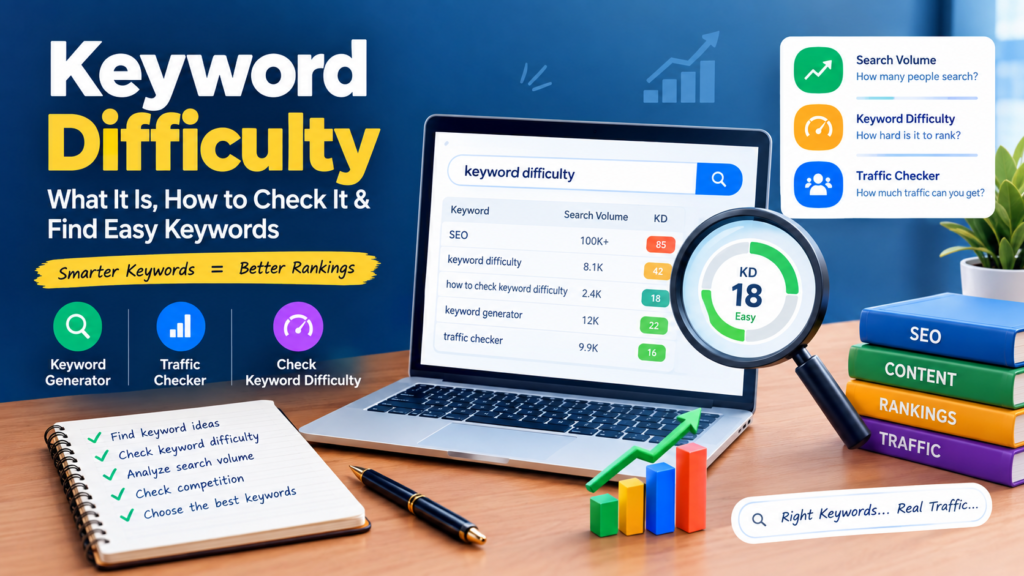
Table of Contents
What Is Keyword Difficulty?
Keyword Difficulty is an SEO metric that estimates how difficult it may be for a webpage to rank organically for a specific keyword.
It is commonly represented as a score from 0 to 100:
| KD Score | Difficulty | General Opportunity |
| 0–10 | Very Easy | Excellent for new websites |
| 11–20 | Easy | Good opportunity |
| 21–40 | Moderate | Requires quality content |
| 41–60 | Difficult | Strong SEO needed |
| 61–80 | Very Difficult | Competitive |
| 81–100 | Extremely Difficult | Usually dominated by strong sites |
Important: KD scores are third party estimates, not a Google ranking factor. Different SEO tools calculate the score differently.
For example:
- “what is SEO” may have high competition.
- “what is keyword difficulty in SEO” may have lower competition.
- “keyword difficulty for beginners” may be even easier to target.
The more specific the search query, the more likely it is that you can find a lower competition opportunity.
Why Is Keyword Difficulty Important?
Keyword Difficulty helps you avoid spending months targeting keywords that may be unrealistic for your website.
Imagine you have a new technology blog.
You discover:
Keyword: SEO
It has enormous search demand, but competing websites include established SEO platforms, major technology websites, and industry authorities.
Instead of immediately targeting “SEO,” you could target more specific keywords such as:
- what is SEO for beginners
- how SEO works for beginners
- keyword difficulty explained
- how to check keyword difficulty
- easy SEO keywords for new websites
These keywords may have lower search volume, but they can provide a much better opportunity for a growing website.
The basic idea is:
Lower competition + relevant search intent + useful content = better ranking opportunity
How to Calculate Keyword Difficulty ?
Different SEO platforms use different formulas, but several factors commonly influence their difficulty scores.
1. Backlinks
Backlinks are links from other websites pointing to a webpage.
If the pages ranking for a keyword have hundreds or thousands of strong backlinks, competing against them can be difficult.
For example:
Suppose the top 10 results for:
“best SEO tools”
have strong backlink profiles.
A new website with very few backlinks may struggle to outrank them.
2. Domain Authority and Website Strength
Established websites often have advantages such as:
- Strong backlink profiles
- Large amounts of quality content
- Brand recognition
- Topical authority
- Long publishing history
A new website should therefore consider targeting less competitive keywords first.
3. Content Quality
Backlinks aren’t everything.
Google wants to provide useful results that satisfy the searcher’s intent.
If the current search results provide poor or incomplete information, a well researched article may have an opportunity even when the keyword appears competitive.
4. Search Intent
Search intent describes what the user actually wants when searching for something.
Common search intents include:
- Informational: “What is Keyword Difficulty?”
- Commercial: “Best keyword research tools”
- Transactional: “Buy SEO software”
- Navigational: “Ahrefs keyword explorer”
Understanding intent is essential because a page can have excellent SEO metrics but still fail if it doesn’t satisfy what users are looking for.
Keyword Difficulty vs Search Volume
One common SEO mistake is choosing keywords only because they have high search volume.
Consider these two keywords:
| Keyword | Monthly Searches | KD | Potential |
| SEO | Very High | Very High | Difficult |
| Keyword difficulty for beginners | Lower | Low/Moderate | Easier |
The first keyword looks attractive because of its huge search volume.
However, the second keyword may be much more realistic for a smaller website.
Remember:
Search volume tells you how much demand exists.
Keyword Difficulty tells you how competitive the ranking opportunity may be.
You should consider both.
How to Check Keyword Difficulty
You can check keyword difficulty using popular SEO and keyword research tools.
Examples include:
- Ahrefs
- Semrush
- Moz Keyword Explorer
- Ubersuggest
- Google Keyword Planner
- Keyword tools with SERP analysis
The exact score can differ between tools, so don’t treat one number as absolute truth.
Basic process
- Enter your target keyword.
- Check its search volume.
- Check the Keyword Difficulty score.
- Examine the current Google results.
- Analyze the websites ranking on page one.
- Look at backlinks and content quality.
- Compare related keywords.
- Choose the keyword with the best realistic opportunity.
Example: A New Technology Blog
Let’s say you run a new technology blog.
You want to write an article about SEO.
You use a keyword generator and discover these ideas:
| Keyword | Search Demand | Difficulty | Intent |
| SEO | Very High | Very High | Informational |
| SEO basics | High | High | Informational |
| what is SEO | High | High | Informational |
| keyword difficulty | Medium | Medium | Informational |
| how to check keyword difficulty | Medium | Lower | Informational |
| keyword difficulty for beginners | Lower | Lower | Informational |
Instead of immediately targeting “SEO,” you could create a detailed article around:
“Keyword Difficulty: What It Is, How to Check It & Find Easy Keywords”
Then create supporting articles around related long tail queries.
This strategy can help a new website build topical relevance before attempting highly competitive keywords.
What Is a Keyword Generator?
A keyword generator is an SEO tool that generates keyword ideas based on a seed keyword.
For example, you enter:
Seed keyword: cyber security
A keyword generator may provide ideas such as:
- what is cyber security
- types of cyber security
- cyber security for beginners
- cyber security fundamentals
- cyber security tools
- how cyber security works
- cyber security career roadmap
You can then evaluate each keyword based on:
- Keyword Difficulty
- Search volume
- Search intent
- Competition
- Relevance
- Business or informational value
Pro Tip
Don’t simply choose the keyword with the highest search volume.
Look for keywords where competition is reasonable and the search intent matches your content.
What Is a Traffic Checker?
A traffic checker is a tool used to estimate website traffic or analyze traffic related information.
Depending on the tool, you may be able to investigate:
- Estimated organic traffic
- Top performing pages
- Traffic sources
- Organic keywords
- Competitor traffic
- Traffic trends
- Top landing pages
A traffic checker can be useful when researching competitors.
For example, suppose a competing website ranks for:
“how to check keyword difficulty”
You can investigate its estimated organic traffic and identify other keywords bringing visitors to that page.
This can help you discover additional content opportunities.
Keyword Difficulty and Traffic Checker: How They Work Together
These tools answer different questions.
Keyword Difficulty asks:
“How difficult might it be to rank for this keyword?”
Traffic checker asks:
“How much traffic might this website or page be receiving?”
Using both can give you a broader picture.
For example:
Keyword: best keyword research tools
You might discover that the keyword is highly competitive.
A traffic checker may show that the websites ranking for it receive significant organic traffic.
Instead of competing directly, you could identify related long tail keywords such as:
- best keyword research tools for beginners
- free keyword research tools
- keyword research tools for small websites
- easy keyword research tools for SEO beginners
These may provide more realistic opportunities.
Example: Choosing a Keyword for a Blog Article
Imagine you want to write about Burp Suite.
You use a keyword generator and find:
- burp suite
- what is burp suite
- how to use burp suite
- burp suite download for Windows
- Burp Suite Professional
- Burp Suite tutorial for beginners
Now you check the competition.
Suppose the broad keyword “Burp Suite” is highly competitive.
Instead of targeting only that keyword, you could create an article focused on:
“What Is Burp Suite? How to Use It & Install It for Beginners”
The article can naturally cover related topics such as:
- What is Burp Suite?
- How to use Burp Suite
- Burp Suite download for Windows
- How to install Burp Suite
- Burp Suite Professional
- Burp Suite Proxy
- Burp Suite Scanner
This creates a more comprehensive resource while targeting multiple relevant search queries.
How to Find Low Difficulty Keywords
If you have a new website, low difficulty keywords can be an effective starting point.
Follow this process.
Step 1: Choose a Seed Keyword
Start with a broad topic.
Examples:
- SEO
- Cyber Security
- Python
- WordPress
- Digital Marketing
- Excel
Step 2: Use a Keyword Generator
Enter your seed keyword into a keyword research tool.
Generate dozens or hundreds of related ideas.
Step 3: Filter by Keyword Difficulty
Look for keywords with relatively low difficulty.
For example:
KD 5–20 can be attractive for a newer website, but the appropriate threshold depends on your site’s authority and the tool’s scoring system.
Step 4: Check Search Intent
Ask:
What does someone expect to see when they search this keyword?
If the keyword is:
“what is keyword difficulty?”
the searcher probably wants an explanation.
Your article should therefore explain the concept clearly rather than trying to sell a product.
Step 5: Analyze Google’s First Page
Don’t rely only on the KD score.
Search the keyword on Google and examine the top results.
Look for:
- Website authority
- Content depth
- Content freshness
- Backlinks
- Search intent
- Page quality
- Featured snippets
- People Also Ask results
This manual SERP analysis is extremely valuable.
Don’t Trust Keyword Difficulty Blindly
Keyword Difficulty is an estimate, not a guarantee.
A keyword with KD 10 isn’t automatically easy.
Likewise, a keyword with KD 40 isn’t necessarily impossible.
For example, a low KD keyword might still be difficult if:
- Search intent is misunderstood.
- Top results have extremely strong topical authority.
- Your content is thin.
- Your website has little authority.
- The keyword is highly specific but has very strong competitors.
Therefore, combine the metric with real SERP analysis.
A Simple Keyword Difficulty Strategy for New Websites
If your website is relatively new, consider this approach:
Stage 1: Very Easy Keywords
Target keywords with relatively low competition.
Examples:
- specific questions
- long tail keywords
- beginner tutorials
- troubleshooting queries
- narrow informational topics
Stage 2: Moderate Keywords
Once you build content and authority, target broader topics.
Stage 3: Competitive Keywords
After developing strong topical authority and backlinks, compete for higher difficulty keywords.
This creates a gradual SEO growth strategy.
Keyword Difficulty Formula for Practical SEO
You don’t need a complicated mathematical formula to choose keywords.
A practical evaluation can be:
Keyword Opportunity = Relevance + Search Intent + Traffic Potential − Competition
For example:
| Factor | Score |
| Relevance | 10/10 |
| Search Intent Match | 10/10 |
| Traffic Potential | 7/10 |
| Competition | 3/10 |
| Overall Opportunity | High |
The exact numbers aren’t a Google formula. They’re simply a useful framework for comparing keywords.
Long Tail Keywords Can Reduce Competition
Long tail keywords usually contain more words and have a more specific search intent.
Compare:
Short keyword:
SEO
Long tail keyword:
how to check keyword difficulty for SEO beginners
The first keyword is broad and highly competitive.
The second keyword is much more specific.
Long tail queries can provide:
- Lower competition
- More specific intent
- Higher relevance
- Better conversion potential
- Easier content targeting
However, don’t assume every long tail keyword is easy. Always analyze the actual SERP.
Common Keyword Difficulty Mistakes
Mistake 1: Choosing Only High Volume Keywords
High volume does not guarantee traffic.
If you cannot rank, the search volume doesn’t help you.
Mistake 2: Ignoring Search Intent
Your article must satisfy the reason behind the search.
Mistake 3: Relying on One SEO Tool
Different platforms calculate KD differently.
Compare data and inspect Google’s results yourself.
Mistake 4: Ignoring Competitors
Always examine the pages currently ranking.
Mistake 5: Keyword Stuffing
Using the keyword repeatedly doesn’t make an article rank better.
Write naturally and cover the topic comprehensively.
Keyword Difficulty Checklist
Before targeting a keyword, ask:
- Is the keyword relevant to my website?
- What is the search intent?
- What is the Keyword Difficulty?
- What is the estimated search volume?
- Can my website realistically compete?
- Who currently ranks on page one?
- Are the top results high authority websites?
- Do the current pages fully answer the query?
- Can I create a better and more useful resource?
- Are there related long tail keywords?
- Can I build supporting content around the topic?
If most answers are positive, the keyword may be worth targeting.
Conclusion
Keyword Difficulty is one of the most useful metrics for building a practical SEO strategy. It helps you understand competition before investing time in creating content.
However, don’t make your SEO decisions based on KD alone.
Use a keyword generator to discover ideas, check keyword difficulty to estimate competition, use a traffic checker to investigate traffic opportunities, and manually analyze Google’s search results before choosing your target keyword.
The best keyword is not necessarily the one with the highest search volume. It is the keyword where your website can provide the right answer to the right audience with a realistic opportunity to rank.
For a growing website, a smart strategy is to start with relevant, specific, lower competition keywords, build topical authority, and gradually move toward more competitive search terms.