Keyword Clustering A Complete SEO Guide with Examples
Keyword clustering is an important SEO technique that helps you organize related keywords into groups based on their search intent, meaning, and topical relationship. Instead of creating a separate page for every similar keyword, keyword clustering helps you identify keywords that can be targeted together on one comprehensive page.
For example, instead of creating separate articles for:
- What is keyword clustering?
- Keyword clustering SEO
- How does keyword clustering work?
- Keyword clustering tools
- Benefits of keyword clustering
You can create one authoritative guide that covers the entire topic.
This approach can improve your website’s topical relevance, content structure, internal linking, and ability to satisfy different but closely related searches.
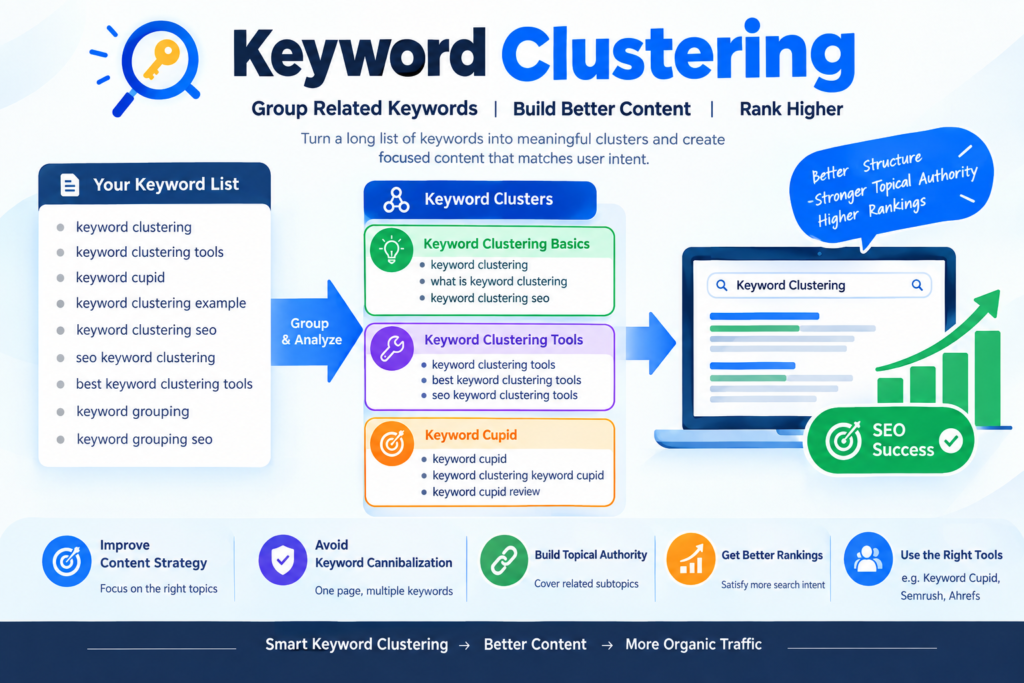
Table of Contents
What Is Keyword Clustering?
Keyword clustering is the process of grouping similar or closely related keywords into logical clusters according to their search intent, topic, and relationship.
A keyword cluster usually contains:
- A primary keyword
- Closely related secondary keywords
- Long tail keywords
- Question based searches
- Synonyms and variations
- Related subtopics
For example, imagine you want to create content about cyber security.
Your keyword research might produce:
- cyber security
- what is cyber security
- cyber security definition
- types of cyber security
- cyber security basics
- cyber security for beginners
- importance of cyber security
- cyber security examples
Instead of treating every keyword as a completely separate topic, you can analyze the search intent and organize them into appropriate clusters.
Simple Keyword Clustering Example
| Keyword | Possible Cluster |
| what is cyber security | Cyber Security Basics |
| cyber security definition | Cyber Security Basics |
| cyber security for beginners | Cyber Security Basics |
| types of cyber security | Types of Cyber Security |
| network security | Cyber Security Types |
| web security | Cyber Security Types |
| endpoint security | Cyber Security Types |
The result is a more organized SEO content strategy.
Why Is Keyword Clustering Important for SEO?
Keyword clustering SEO is useful because modern search engines don’t evaluate pages only by looking for one exact keyword.
Search engines increasingly try to understand:
- The overall topic
- Search intent
- Relationships between concepts
- Context
- Content completeness
- User experience
Keyword clustering helps you build content around topics rather than isolated keywords.
1. Prevents Keyword Cannibalization
Suppose you publish these three pages:
- What Is Keyword Clustering?
- Keyword Clustering SEO
- How to Do Keyword Clustering
If all three pages target almost identical search intent, they may compete with each other.
Keyword clustering can reveal that these keywords belong to the same intent group.
You can then create one stronger page covering all of them.
2. Helps Build Topical Authority
Imagine a website publishes one article about SEO.
Another website publishes:
- Keyword research
- Search intent
- Keyword clustering
- Long tail keywords
- Short tail keywords
- On page SEO
- Technical SEO
- Internal linking
- SEO content strategy
The second website demonstrates broader topical coverage.
Keyword clustering can help you plan this content systematically.
3. Creates Better Content Structure
Clusters can become:
- Main articles
- Subtopics
- Supporting articles
- FAQ sections
- Internal linking opportunities
For example:
Main Topic: Keyword Research
Supporting topics:
- What Is Keyword Research?
- Short Tail Keywords
- Long Tail Keywords
- Search Intent
- Keyword Clustering
- Keyword Difficulty
- Keyword Search Volume
This creates a logical content architecture.
How Does Keyword Clustering Work?
A typical keyword clustering process involves several steps.
Step 1: Collect Keywords
Start with keyword research.
You can collect keywords from:
- Google Search
- Google Keyword Planner
- Google Search Console
- Ahrefs
- Semrush
- Moz
- Ubersuggest
- AnswerThePublic
- Keyword clustering tools
Suppose your website focuses on WordPress SEO.
You might collect:
- WordPress SEO
- WordPress SEO guide
- SEO for WordPress
- WordPress SEO tips
- WordPress SEO settings
- WordPress SEO checklist
- WordPress SEO plugins
- best SEO plugin for WordPress
Don’t immediately create separate articles for every keyword.
First, analyze their relationship.
Step 2: Identify Search Intent
Search intent is one of the most important parts of keyword clustering.
Common search intent categories include:
Informational Intent
Users want information.
Examples:
- what is keyword clustering
- how does keyword clustering work
- what is search intent
Commercial Investigation
Users are researching products or tools.
Examples:
- best keyword clustering tools
- Keyword Cupid review
- keyword clustering software
Transactional Intent
Users are ready to take an action.
Examples:
- buy SEO software
- keyword clustering tool pricing
- SEO software subscription
Navigational Intent
Users are looking for a specific website or platform.
Examples:
- Keyword Cupid login
- Ahrefs login
- Semrush login
Keywords with completely different search intent may need separate pages.
Step 3: Find Semantic Relationships
Next, identify keywords that mean similar things or describe the same topic.
For example:
- keyword clustering
- keyword grouping
- keyword grouping SEO
- SEO keyword clustering
- keyword cluster
These keywords are closely related.
They may potentially belong to the same content cluster.
However, semantic similarity alone isn’t enough. You should also check whether users expect similar content when searching for each term.
Step 4: Analyze Search Results
One practical method is to compare the search results for different keywords.
Suppose you search:
keyword clustering
and:
SEO keyword clustering
If Google shows many of the same pages for both searches, that is a useful signal that the queries have similar intent.
If the results are completely different, they may deserve separate content.
This is sometimes called SERP based keyword clustering.
Step 5: Create Keyword Groups
After analyzing intent and relationships, organize the keywords.
For example:
Cluster 1: Keyword Clustering Basics
- keyword clustering
- what is keyword clustering
- keyword clustering SEO
- keyword grouping
- SEO keyword grouping
Cluster 2: Keyword Clustering Tools
- keyword clustering tools
- best keyword clustering tools
- SEO keyword clustering tools
- automated keyword clustering
Cluster 3: Keyword Cupid
- keyword cupid
- keyword clustering Keyword Cupid
- Keyword Cupid SEO
- Keyword Cupid keyword clustering
- Keyword Cupid review
The exact grouping should be validated against search intent and SERP behavior rather than based only on similar words.
What Is Keyword Cupid?
Keyword Cupid is an SEO keyword clustering platform designed to help organize large keyword lists into meaningful groups.
Instead of manually reviewing thousands of keywords, an automated clustering tool can analyze keyword relationships and help identify potential topic groups.
For example, imagine you have 500 keywords related to digital marketing.
Manually organizing all 500 keywords could take significant time.
A keyword clustering tool such as Keyword Cupid can help divide them into groups such as:
- Digital Marketing Basics
- Social Media Marketing
- Email Marketing
- Content Marketing
- SEO
- PPC Advertising
- Affiliate Marketing
This can make content planning considerably easier.
Keyword Clustering Keyword Cupid: How It Can Be Used
A practical keyword clustering Keyword Cupid workflow might look like this:
Step 1: Prepare Your Keyword List
Export your keyword research into a spreadsheet.
Example:
| Keyword | Search Volume | Difficulty |
| digital marketing | 50,000 | High |
| digital marketing strategy | 8,000 | Medium |
| social media marketing | 40,000 | High |
| social media strategy | 5,000 | Medium |
| email marketing | 30,000 | High |
| email marketing strategy | 4,000 | Medium |
Step 2: Upload the Keywords
Import your keyword list into your clustering workflow or supported SEO platform.
Step 3: Analyze the Groups
The system identifies relationships between keywords and creates potential clusters.
Step 4: Review the Clusters
Don’t blindly publish content based on automated grouping.
Manually review each cluster.
Ask:
Would one page genuinely satisfy users searching for these keywords?
If yes, the keywords may belong on one page.
If not, separate them.
Keyword Clustering Tools
There are many keyword clustering tools available for SEO professionals.
Some tools and approaches include:
- Keyword Cupid
- Semrush
- Ahrefs
- SE Ranking
- LowFruits
- Keyword Insights
- Google Search Console data
- Spreadsheet based clustering
- Custom scripts and NLP based workflows
The best choice depends on your keyword volume, budget, workflow, and level of automation.
Automated vs Manual Keyword Clustering
Manual Clustering
You analyze keywords yourself.
Advantages:
- Greater control
- Better understanding of search intent
- No expensive software required
- Useful for small keyword lists
Disadvantages:
- Time consuming
- Difficult with thousands of keywords
- More subjective
Automated Clustering
Software analyzes keywords automatically.
Advantages:
- Faster
- Scales to large keyword lists
- Reduces repetitive work
- Useful for large SEO projects
Disadvantages:
- Automated groups can be imperfect
- Search intent still requires human review
- Some tools require paid subscriptions
The strongest workflow is often automation followed by human validation.
Keyword Clustering Example: SEO Website
Imagine you run a technology education website and want to build a topic around SEO.
Your keyword research produces 30 keywords.
Some of them are:
- what is SEO
- SEO meaning
- SEO definition
- how SEO works
- SEO for beginners
- SEO tutorial
- SEO techniques
- SEO strategies
- technical SEO
- on page SEO
- off page SEO
- keyword research
- keyword clustering
- search intent
- backlinks
- internal linking
Instead of creating 30 small articles, you could organize them into larger topical groups.
Cluster A: SEO Basics
- what is SEO
- SEO meaning
- SEO definition
- how SEO works
- SEO for beginners
Cluster B: SEO Strategies
- SEO techniques
- SEO strategies
- SEO best practices
- SEO tips
Cluster C: Technical SEO
- technical SEO
- technical SEO checklist
- website speed
- crawlability
- indexing
Cluster D: Keyword Research
- keyword research
- keyword clustering
- search intent
- long tail keywords
- short tail keywords
Cluster E: Link Building
- backlinks
- link building
- internal linking
- external links
This creates a scalable SEO content plan.
Keyword Clustering Example: E Commerce Website
Imagine an online store selling laptops.
Your keyword research produces:
- laptop
- gaming laptop
- best gaming laptop
- gaming laptop under $1,000
- cheap gaming laptop
- gaming laptop for students
- business laptop
- laptop for programming
- laptop for video editing
You could create different clusters based on search intent.
Gaming Laptop Cluster
- gaming laptop
- best gaming laptop
- gaming laptop under $1,000
- cheap gaming laptop
- gaming laptop for beginners
Programming Laptop Cluster
- laptop for programming
- best laptop for programmers
- laptop for coding
- laptop for software development
Student Laptop Cluster
- laptop for students
- best student laptop
- affordable laptop for students
The clusters can then support category pages, buying guides, product pages, and comparison content.
Keyword Clustering Example: Cyber Security
Suppose you want to build a cyber security learning section.
Your keyword list includes:
- what is cyber security
- cyber security types
- network security
- web security
- endpoint security
- information security
- firewall
- VPN
- IDS
- IPS
- malware
- phishing
- ransomware
A possible structure could be:
Cyber Security
→ Cyber Security Basics
→ Network Security
→ Web Security
→ Endpoint Security
→ Firewalls
→ VPN
→ IDS and IPS
→ Malware
→ Phishing
→ Ransomware
This structure allows you to create a strong pillar page supported by detailed articles.
Keyword Clustering SEO Best Practices
To get the most value from keyword clustering SEO, follow these practices.
1. Don’t Cluster Keywords Only Because They Look Similar
For example:
- Apple laptop
- Apple fruit
contain the same word but represent completely different topics.
Always consider search intent and context.
2. Don’t Create One Page for Every Keyword
If ten keywords have essentially the same intent, creating ten nearly identical pages can create unnecessary content overlap.
One comprehensive page may be more appropriate.
3. Use Search Results as Evidence
Search engine results provide useful clues about whether two queries have similar intent.
Compare the ranking pages for important keywords before combining them.
4. Use One Primary Keyword Per Page
Choose a clear primary topic for each page.
Then naturally cover closely related keywords throughout the content.
For example:
Primary keyword: Keyword Clustering
Supporting terms:
- keyword clustering SEO
- keyword clustering tools
- keyword Cupid
- keyword grouping
- SEO keyword clustering
This provides a clear topical focus without forcing exact match phrases repeatedly.
Keyword Clustering vs Keyword Mapping
These concepts are related but different.
Keyword Clustering
Groups related keywords according to topic and intent.
Keyword Mapping
Assigns keywords or keyword clusters to specific website URLs.
For example:
| Keyword Cluster | Target URL |
| Keyword Clustering | /keyword-clustering/ |
| Keyword Research | /keyword-research/ |
| Search Intent | /search-intent/ |
| Long-Tail Keywords | /long-tail-keywords/ |
Clustering generally happens before mapping.
Keyword Clustering vs Keyword Stuffing
These are completely different concepts.
Keyword clustering means organizing related keywords into meaningful groups.
Keyword stuffing means unnaturally repeating keywords in an attempt to manipulate search rankings.
For example, this is poor writing:
Keyword clustering is important because keyword clustering helps keyword clustering SEO and keyword clustering tools help with keyword clustering.
A better approach is natural language:
Keyword clustering organizes related search queries into groups so you can create focused content that satisfies a broader set of closely related searches.
The goal should always be useful content for people first.
How to Create Keyword Clusters in Excel or Google Sheets
You don’t necessarily need expensive software.
For a small keyword list, you can create clusters manually.
Suppose your spreadsheet contains:
| Keyword | Intent | Topic | Cluster |
| what is SEO | Informational | SEO Basics | SEO Basics |
| SEO definition | Informational | SEO Basics | SEO Basics |
| SEO tutorial | Informational | SEO Basics | SEO Basics |
| technical SEO | Informational | Technical SEO | Technical SEO |
| SEO audit | Commercial/Informational | SEO Audit | SEO Audit |
You can use filters, sorting, categories, and formulas to organize the data.
For larger datasets, automated clustering can save considerable time.
How Many Keywords Should Be in One Cluster?
There is no universal number.
A cluster could contain:
- 3 keywords
- 10 keywords
- 50 keywords
- Hundreds of keywords
The important question isn’t:
“How many keywords should I put together?”
Instead ask:
“Can one page satisfy the search intent behind these keywords?”
If yes, they may belong to one cluster.
If the intent differs substantially, create separate clusters.
Benefits of Keyword Clustering
Keyword clustering can provide several SEO benefits.
Better Content Planning
You can identify which topics deserve dedicated pages.
Reduced Content Duplication
Similar search queries can be consolidated into stronger resources.
Improved Internal Linking
Clusters naturally reveal relationships between pages.
Better Topical Coverage
You can systematically cover important subtopics.
Efficient Keyword Targeting
One well optimized page can potentially rank for many closely related queries.
Scalable SEO Strategy
Large websites can organize thousands of keywords into manageable content groups.
Common Keyword Clustering Mistakes
Mistake 1: Relying Completely on Software
Automated clustering is helpful, but it isn’t perfect.
Always review important clusters manually.
Mistake 2: Ignoring Search Intent
Two keywords can be semantically related but require different content.
Mistake 3: Creating Too Many Similar Pages
This can create overlapping content and keyword cannibalization.
Mistake 4: Focusing Only on Search Volume
A keyword with lower search volume may have stronger relevance and conversion potential.
Mistake 5: Forcing Every Keyword Into an Article
You don’t need to mention every keyword exactly.
Write naturally and comprehensively.
A Simple Keyword Clustering Workflow
Here is a practical workflow you can use for your own website:
1. Research keywords
↓
2. Export the keyword list
↓
3. Remove irrelevant keywords
↓
4. Identify search intent
↓
5. Compare SERPs
↓
6. Group related keywords
↓
7. Review clusters manually
↓
8. Select primary keywords
↓
9. Map clusters to URLs
↓
10. Create comprehensive content
↓
11. Add internal links
↓
12. Monitor rankings and Search Console data
This workflow combines keyword research, intent analysis, content planning, and SEO execution.
Conclusion
Keyword clustering is a practical SEO strategy for turning a large, unorganized keyword list into a structured content plan.
Instead of creating a separate page for every keyword, analyze the relationship between keywords and determine which queries can be satisfied by the same resource.
Tools such as Keyword Cupid and other keyword clustering tools can accelerate the process, especially for large keyword datasets. However, automation should not replace human judgment.
The most effective approach is:
Research → Cluster → Analyze Intent → Validate SERPs → Map Keywords → Create Useful Content → Internally Link → Monitor Results
When implemented correctly, keyword clustering SEO can help you build a more organized website, strengthen topical coverage, reduce unnecessary content overlap, and create resources that satisfy users searching for closely related information.